
A few papers we think are worth your time, followed by the complete list. For the always-current version, see Google Scholar.
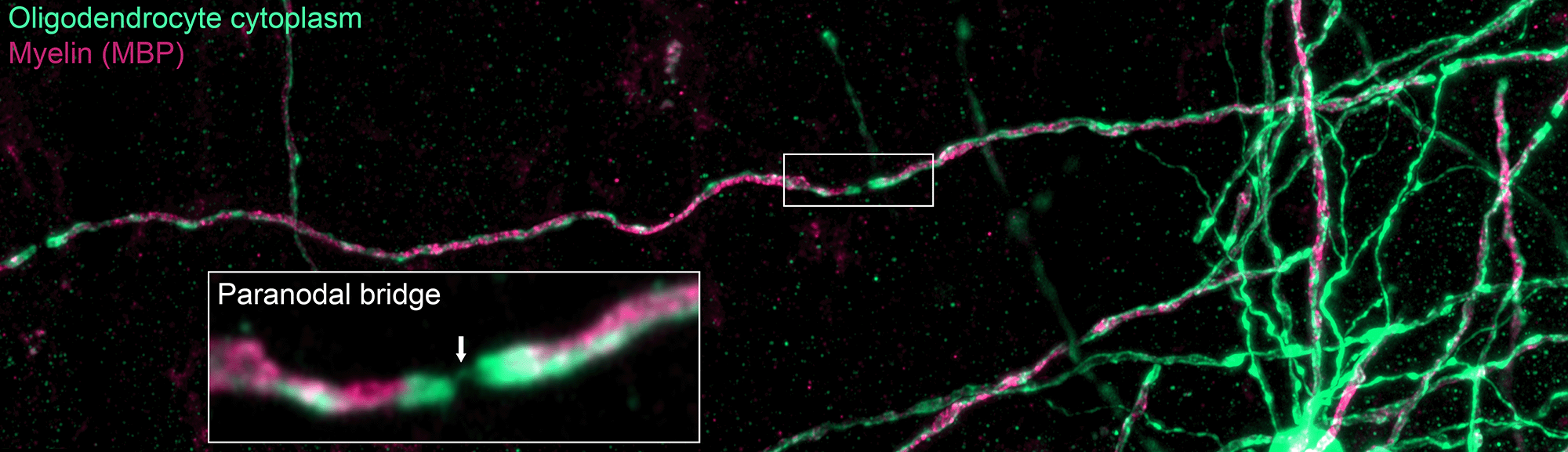
Textbook models say an oligodendrocyte wraps an axon steadily and symmetrically. By following individual sheaths as they formed, we found that wrapping is asynchronous — leaving partially wrapped zones that let a single cell reach past a branch point and link neighboring sheaths by thin cytoplasmic bridges. This lets one cell myelinate more of a circuit than thought possible, but leaves the resulting chains vulnerable to degeneration with age.
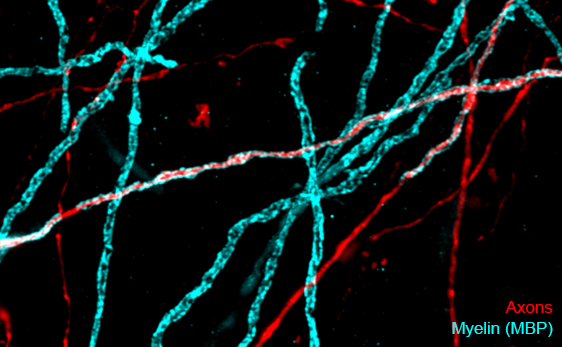
The cortex doesn't myelinate every axon the same way. We mapped myelination across cortical neuron types and found a clear hierarchy of preferences — then showed that after demyelination, regeneration reshapes those patterns rather than faithfully restoring them, raising new questions about what the patterns are for.
Call CL, Neely SA, Early JJ, James OG, Zoupi L, Williams AC, Xu YKT, Chandran S, Lyons DA, Monk KR, Bergles DE. Flexible ensheathment of axons enables myelination of complex CNS networks. Nature 654, 724–733 (2026). DOI
Hupp MT, Santos EN, Heo D, Call CL, Guttenplan KA. Vesicle fusion in oligodendrocyte maturation and myelination. Journal of Neuroscience 44(16) (2024). DOI
Call CL, Bergles DE. Cortical neurons exhibit diverse myelination patterns that scale between mouse brain regions and regenerate after demyelination. Nature Communications 12, 4767 (2021). DOI
Xu YKT, Call CL, Sulam J, Bergles DE. Automated in vivo tracking of cortical oligodendrocytes. Frontiers in Cellular Neuroscience 15, 667595 (2021). DOI
Orthmann-Murphy J, Call CL, Molina-Castro GC, Hsieh YC, Rasband MN, Calabresi PA, Bergles DE. Remyelination alters the pattern of myelin in the cerebral cortex. eLife 9, e56621 (2020). DOI
Heo D, Call CL, Chen J, Freeman MR, Monk KR. All-in-one, Cas13d-based cell-specific gene knockdown system for zebrafish. bioRxiv (2026). DOI
Coombs AM, Heo D, Orlin DJ, Call CL, Bechler ME, Murthy SE, Emery B, Monk KR. PIEZOs regulate oligodendrocyte sheath formation, expansion, and myelination potential. bioRxiv (2026). DOI
Zhu B, Li T, Rodrigues B, Piller M, Call CL, Mogha A, Belloso Iguerategui A, Chiou B, Schmidt R, Wangzhou A, Thurber AL, Dee M, Larson CH, Monk KR, Piao X. Pre-myelinating oligodendrocyte ADGRG1 is required for axon ensheathment and CNS myelin formation. bioRxiv (2026). DOI
Piller M, Doan RA, Call CL, Smith SM, Monk KR. P/Q-type voltage-gated calcium channels regulate calcium signaling and developmental myelination in oligodendrocyte lineage cells. bioRxiv (2025). DOI
Miramontes TG, Hamling KR, Doan RA, Singh S, Collins HY, Emery B, Call CL, Monk KR. Activation of cannabinoid receptor CB1 leads to aberrant myelination in development. bioRxiv (2025). DOI
For a complete and current list, see Google Scholar.
Also on ORCID.